
Outbound vs Inbound Sales: The Real Math Small Businesses Never Run
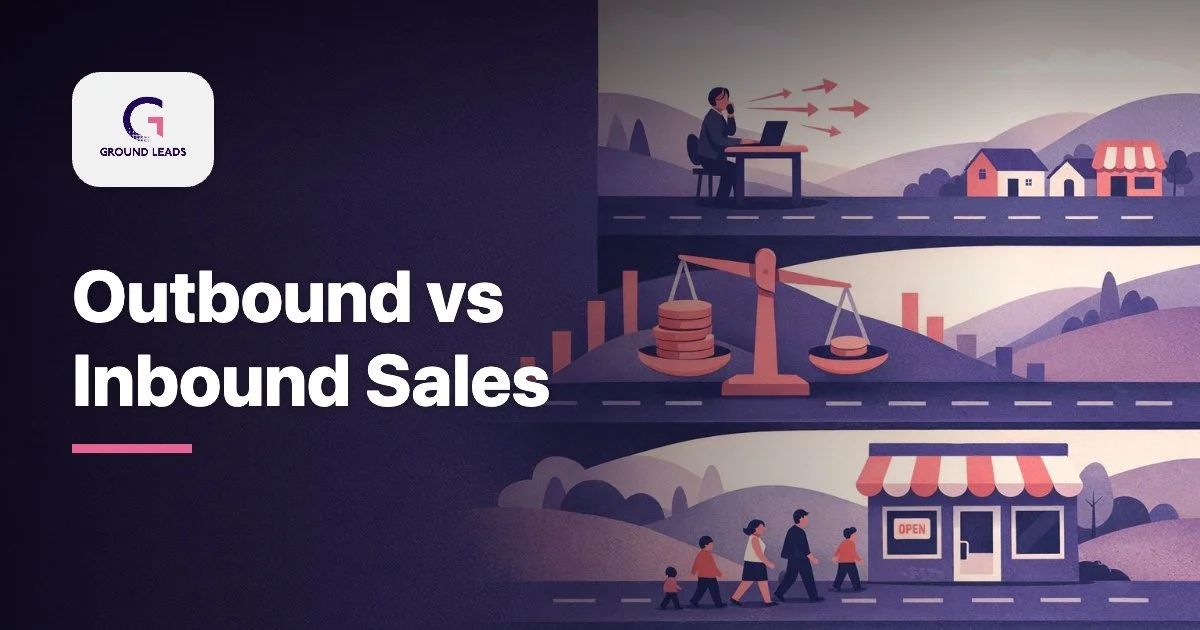
Ask ChatGPT or a consultant whether you should do inbound or outbound, and you'll get the same shrug every time. "It depends on your business." True. Also useless.
Here's the version nobody wants to say out loud: under 50 customers, under $2M in revenue, inbound by itself will not save you this year. Content marketing isn't broken. It's just slow, and slow is a luxury most small businesses can't afford while the bills come due monthly.
Run the math with me.
What Inbound and Outbound Actually Mean
Inbound means someone finds you first. A prospect Googles a problem, lands on your site, downloads a guide, fills out a form weeks later. You're reacting to interest that already existed.
Outbound flips the order. You build a list that matches your ideal customer profile. You put a sequence or a human in front of the right person. A conversation exists that didn't exist an hour ago, because you made it exist. If you want the fuller picture on how these motions fit into a broader lead generation for small businesses strategy, that's worth a separate read.
One waits for the phone to ring. The other dials it.
The Timeline Problem Nobody Puts in the Pitch Deck
Inbound carries a trust tax baked into how it works. Google needs months before it trusts a new domain. Your content needs volume before anything ranks. Readers need several touches before they'll even consider converting. A founder starting SEO from zero should expect 6 to 12 months before pipeline shows up in any meaningful way.
You hired a writer. You published every week for four months. You refreshed the analytics dashboard every morning like it owed you something.
Nothing happened.
Or something happened, and it was the wrong traffic entirely, people hunting for free advice who were never going to open their wallet.
Outbound compresses that timeline hard. A tight ICP, a clean list, and a sequence that actually runs can produce qualified conversations by week two. Not closed revenue yet. Conversations. But a small business that needs cash this quarter can't live on content that pays off in 2027.
What Each One Actually Costs, And Where That's Changing
Inbound looks cheap on a spreadsheet. It rarely stays cheap in practice. A single piece of SEO content, written and optimized properly with real strategy behind it, has historically cost anywhere from a few hundred dollars to a couple thousand. You need dozens of those pieces before organic traffic becomes a real channel. Add it up and you're deep into five figures before a single meeting gets booked.
That's the part of this article I need to update, because the math just moved. This is where I'll point you to a partner of ours, ScribeGap, built specifically to attack that cost problem. The timeline doesn't change. You still need months before Google trusts the domain and the content builds enough volume to rank. What changes is the spend required to get there. You're no longer paying a writer per article, a strategist per outline, and an editor per round of revisions just to accumulate the dozens of pieces inbound actually needs. The original angle of this article still holds: inbound is slow, and slow is hard to fund. ScribeGap doesn't make it fast. It makes the "fund it" part a lot less painful while you wait on the slow part to pay off.
Worth saying plainly, since it's relevant to the point: the first draft of this article was built with ScribeGap's help. If you're wondering what the output actually looks like before you hand over a few thousand dollars to a content agency, you're reading it.
Outbound's cost structure is more honest. It's labor plus tools, not labor plus hope. A part-time SDR, or a lean outbound setup with the data and sequencing software included, typically runs $5K to $20K for a quarter of sustained activity. That buys prospecting, sequencing, and a pipeline number you can actually forecast. If you're trying to decide whether to build that function in-house or hand it off, this outsourced sales vs in-house SDR cost breakdown lays out exactly where the money goes either way.
Neither figure is small money for a small business. One produces a forecast by day 30. The other produces a traffic graph you'll stare at alone at 11pm, now at a lower hourly burn rate than it used to.
This Is Where Founders Set $300K on Fire
The expensive mistake isn't picking the wrong channel. It's picking both, badly, at the same time, with no plumbing underneath either one.
Here's how it usually goes. A founder reads a post exactly like this one and decides "we need both." A content freelancer gets hired. A BDR gets pulled off a job board. Neither one gets a system.
No CRM discipline. No shared ICP document. No cadence. No lead scoring. Most of this gets solved by following an actual outbound sales playbook instead of improvising one from job-board hires and good intentions.
Six months later there's a trickle of unqualified inbound leads, a burned-out BDR recycling the same three templates against a list that was never segmented, and a founder staring at $300K in payroll and tools wondering why four deals closed.
Outbound didn't fail. Inbound didn't fail. The setup failed, and setup is the part founders always skip.
When Inbound Actually Wins
Credit where it's due: once inbound works, it works well. Leads who come to you are self-qualified. They already believe they have the problem before you ever get on a call, so your close rate on warm inbound usually beats cold outbound by a wide margin.
Inbound also compounds. A page-one ranking generates leads for years at close to zero marginal cost. Outbound doesn't compound that way; you rebuild the list and rerun the sequence every quarter. It has to keep running. It doesn't idle and still produce.
If your buyer actively searches for a solution like yours, the way people search for accounting software or a plumber, inbound deserves a real budget. If your buyer doesn't yet know the problem has a name, inbound will leave you waiting on a market that was never coming to find you.
When Outbound Wins
Outbound works best with a tightly defined ICP: company size, industry, title, trigger event. Tighten the definition and every number downstream gets better.
It also wins when you're selling something new or unfamiliar. Nobody Googles a category that doesn't exist in their vocabulary yet. Somebody has to walk in and name the problem for them.
The myth that kills outbound before it starts: "cold outreach doesn't work anymore, everyone hates it." That's wrong. Outbound works. Your setup didn't.
Spraying a generic template at 50,000 purchased contacts isn't outbound sales. It's spam with a CRM attached.
Real outbound looks different: a narrow ICP, a first line that references something true about the prospect's actual business, a cadence across email and phone, and follow-up discipline most internal teams never have the headcount to sustain past week two. It's also the lever most founders reach for when they're scaling past the inbound ceiling and realize organic traffic alone has capped their pipeline.
Inbound vs Outbound: The Honest Framework
Stop asking which channel wins. Ask these instead.
Does your buyer already know they have the problem and search for a fix by name? If yes, inbound has pull. If no, outbound has to build the awareness from zero.
Do you need revenue in the next 90 days, or are you building something that pays off in two years? Outbound answers the first. Inbound answers the second.
Can you write your ICP down to the title and the trigger event, with no vague language in the sentence? If yes, outbound ROI climbs fast.
Does your category even show up in a Google search, or are you explaining something buyers haven't named yet?
The businesses that get this right run both, sequenced on purpose. Outbound buys cash flow now. A smaller, steady inbound motion, now cheaper to sustain thanks to tools like ScribeGap, builds the compounding asset underneath it. The failure isn't picking one channel. It's picking both with zero architecture behind either.
If outbound is the gap in your pipeline right now, that's the part we build. Ground Leads sets up the entire outbound engine for small and mid-sized businesses, ICP, list building, sequencing, appointment setting, and we can have an SDR or a full four-person outbound team live within 14 days, running on our own tech stack. Book a short consultation and we'll tell you straight whether outbound makes sense for your numbers before you spend a dollar on it.
Frequently Asked Questions
What is the difference between inbound and outbound sales?
Inbound means the prospect finds you through content, search, or referral, and arrives already somewhat convinced they have a problem. Outbound means you identify the prospect first, build a list against a defined ICP, and initiate the conversation yourself through email, phone, or LinkedIn. Inbound reacts to demand. Outbound creates it.
How long does it take to see results from outbound sales?
A properly built outbound setup, clean ICP, working list, tested sequence, usually produces qualified conversations within two to three weeks. Closed revenue tends to follow within 60 to 90 days, depending on your sales cycle. That ramp beats inbound almost every time, because nobody's waiting on an algorithm to grant trust.
Is cold calling still effective for small businesses?
Yes, especially paired with email against a narrow list instead of a broad one. Phone remains one of the highest-converting touches in a cadence, mostly because so few competitors still bother picking it up. The decay happens when reps dial generic lists with zero research, not because the phone itself stopped working. If you want the actual mechanics, this guide on how to do b2b cold calling breaks down what separates a dial that converts from one that gets hung up on.
How much should a small business budget for outbound sales?
A lean, sustained motion for a quarter generally lands between $5K and $20K once you include a dedicated resource plus prospecting and sequencing tools. That number moves depending on headcount and whether you're running one channel or a full multi-channel cadence. Different providers structure this differently too, so it's worth comparing appointment setting pricing models before you commit to one. Judge it against pipeline generated, not against the sticker price alone.
Can a small business run both inbound and outbound at once?
Yes, and the fastest-scaling businesses usually do, but only once each motion has its own owner and its own system. Run both without a shared CRM, a shared ICP, and a defined handoff, and you'll burn budget on two half-built engines instead of one that actually works. Sequence them: outbound for revenue now, a leaner inbound motion for the asset you're building for later.


Inbound got you to $1-3M ARR. It won't get you to $10M. Here's the brutal playbook for hunting enterprise deals without hiring SDRs or burning six months.