
Ideal Customer Profile: Why Most Founders Are Chasing the Wrong Buyer
You closed 40 deals last year. Revenue looks fine on the dashboard. Then you actually sit down and look at churn, support tickets, and the time your team burned chasing accounts that never should have been in the pipeline.
Half of those 40 customers were a mistake. Not because your product failed them. Because they were never the right fit in the first place.
That's what an ideal customer profile is supposed to prevent. Not a nice-to-have slide in your pitch deck. A filter that keeps your sales team from wasting 90 days chasing a logo that was always going to churn, underpay, or eat your support team alive.
How Do You Define an Ideal Customer Profile?
An ideal customer profile, usually shortened to ICP, is a description of the company that gets the most value from what you sell, pays you the most for it, and sticks around the longest. Not the company most likely to take a sales call. The company most likely to become a repeat, referring, expanding account.
Most founders confuse this with a buyer persona. They're not the same thing.
A buyer persona describes a person: their job title, their daily headaches, what they Google at 11pm when something breaks. An ICP describes a company: its size, its industry, its tech stack, its revenue band, the trigger event that made it ready to buy.
You need both eventually. But if you only have budget and time to build one, build the ICP first. You can have the perfect persona and still pitch it inside a company that was never going to buy, never going to pay on time, or never going to stick around past month three.
A real ICP definition answers four questions, and if you can't answer all four, you don't have an ICP yet. You have a guess.
What size company gets outsized value from what we sell, measured in revenue, headcount, or deal volume?
What industry or vertical sees the fastest time-to-value with us?
What's the trigger event that makes a company ready to buy right now, not someday?
What does a company look like right before it churns or turns into a support nightmare, so we can screen it out?
That last one is the part nobody wants to do. It means going back through your CRM and being honest about which accounts were a waste of your team's time. It's uncomfortable. Do it anyway.
Month 1: The Spray-and-Pray Era
This is where most founders set their sales payroll on fire.
You hire an SDR. You buy a list of 10,000 contacts because the list looked cheap and the title "Head of Operations" sounded close enough. You start emailing everyone who vaguely resembles a buyer.
Open rates look decent. Reply rates are garbage. The few meetings you book are with companies too small to afford you, too big to move fast, or too far outside your actual wheelhouse to ever convert.
Your SDR isn't bad at their job. They're doing exactly what you told them to do: talk to everyone. The problem is upstream. Nobody defined who "everyone" should actually be.
Month 3: The Math Starts to Hurt
By month three you've got a pipeline full of deals that look promising but keep stalling. "Interested, circle back next quarter." "Budget got cut." "Not the right time."
Translation: wrong account, right pitch. You were selling to someone who was never going to buy, no matter how good your messaging was.
This is where founders usually blame the SDR, the script, or the CRM. Rarely do they blame the target list. But the target list is almost always the actual leak in the pipeline, and it's usually the same leak that shows up when a business tries scaling past the inbound ceiling without ever tightening who outbound is actually built for.
Here's the test. Pull your last 20 closed-won deals and your last 20 closed-lost deals. Look at company size, industry, and the reason they bought or didn't. If you see a pattern, you already have the raw material for an ICP. You just haven't written it down.
What Is a Customer Profile Example?
Abstract frameworks don't help anyone at 9pm trying to fix a broken outbound list. So here's a concrete one.
Say you sell inventory management software to e-commerce brands. A customer profile for your business might look like this:
Company doing $2M to $15M in annual online revenue
Selling physical products across 3 or more sales channels (own site, Amazon, a marketplace)
Currently managing inventory in spreadsheets or an outgrown entry-level tool
Recently raised a funding round, hired a new operations lead, or had a stockout incident in the last quarter (the trigger event)
Team of 15 to 60 employees, with at least one dedicated ops or supply chain hire
Notice what's not in there. No "forward-thinking" or "innovative" language. No vague aspirational descriptors. Just numbers, channels, and a trigger that tells you timing is right.
That's a profile a sales team can actually use to build a list. "Innovative mid-market companies" is not. Nobody can search LinkedIn Sales Navigator for "innovative."
What Is an ICP Example?
People use "customer profile" and "ICP" interchangeably, and mostly that's fine. But if you want the sharper version, an ICP example usually gets stacked with firmographic data plus a scoring layer, something your sales team can use to rank accounts, not just describe them.
Take a B2B payroll software company. Their ICP might look like:
Tier A: 50-200 employees, multi-state operations, currently on a legacy payroll provider, HR team of 2+ people. These get called first, every time.
Tier B: 20-50 employees, single-state, founder still handling HR personally. Good fit, slower sales cycle, lower urgency.
Tier C: Under 20 employees or over 500. Technically could buy, but deal size or complexity makes these a poor use of SDR time.
This is the difference between an ICP that sits in a Google Doc nobody opens and one that actually shapes who gets a call today versus who gets a drip campaign in six months. The same tiering logic shows up constantly in SaaS sales strategy, where deal size and urgency decide who a rep calls before lunch and who waits for a nurture sequence.
If your ICP doesn't change how your team prioritizes accounts, it isn't an ICP. It's a poster.
Month 5: The Fix That Actually Works
Here's what changes when a founder finally sits down and builds the real thing instead of the Google Doc version.
You strip the target list from 10,000 loosely-related contacts down to 800 that actually match the profile. Fewer names. Better fit. Reply rates jump, not because the email got cleverer, but because the right people are finally reading it. Most of the mechanics behind that shift are the same ones laid out in any decent outbound lead generation playbook, where the list quality does more work than the copy ever will.
Meeting quality improves before meeting volume does. That's the part founders don't expect. You might book fewer meetings in week one of the new list. But the meetings you do book turn into actual sales cycles, not polite "let's reconnect next quarter" dead ends.
Your SDR stops guessing. They know exactly which accounts to prioritize, which trigger events to watch for, and which titles actually have budget authority. No more spray. No more pray.
The ICP also does something quieter but just as important: it tells you who to say no to. Every inbound lead that doesn't match the profile is a decision, not an automatic yes. Saying no to a bad-fit lead early is cheaper than saying yes and discovering the mismatch three months into onboarding.
What Are 5 Qualities of a Good Customer Service Fit?
This question usually comes from a different angle, people searching for what makes customer service good in general. But there's a version of it that matters directly for ICP work: what qualities make a customer easy and profitable to serve well, not just easy to sell to.
When you're screening accounts against your ICP, look for these traits on the customer side, because they predict whether your team can actually deliver good service to this account long-term.
Realistic expectations. A customer whose expectations match what your product actually does, not what they imagine it could do, is easier to serve well and far less likely to churn out of disappointment.
Clear internal ownership. One named person on their side responsible for the relationship. Accounts with no clear owner generate support chaos because nobody follows through on implementation steps.
Willingness to follow onboarding. Customers who skip setup steps and expect results anyway create a disproportionate share of support tickets and negative reviews.
Budget that matches the problem size. A customer who underfunds the problem they're trying to solve will always feel like your product underdelivered, even when it worked exactly as designed.
Communication that matches your process. If your support model runs on email and documentation, a customer who only wants same-day phone calls will be frustrated no matter how good your actual service is.
These traits rarely show up in a firmographic filter. You find them by looking at your best accounts and asking what made them easy to work with, then building that into how you qualify leads, not just how you pitch them.
Building the List: Where the ICP Actually Earns Its Keep
A written ICP that never touches your prospecting list is a wasted afternoon.
The real test is whether you can hand your ICP to someone building a cold outreach list and they come back with names, not confusion. Company size, industry, trigger event, title with budget authority. If your ICP document answers all four, a prospecting tool or a research hire can turn it into a working list the same week, which is the first real step in building a B2B outbound engine instead of just running another round of cold emails.
If it can't, go back and get more specific. "Mid-market SaaS companies" is not specific. "Series B SaaS companies with 50-150 employees who just hired their first VP of Sales" is specific, and it's the kind of sentence that produces an actual list instead of another vague vertical. Plenty of founders reach this point and realize building and running that machine in-house is slower than handing it to an outsourced sales development team that already has the list-building and sequencing muscle built.
Building the ICP is the strategy part. Turning it into a working outbound engine, the prospecting, the sequencing, the actual appointments on your calendar, is the execution part, and that's where most small teams run out of hours. Ground Leads builds that engine for you, deploying dedicated SDRs who prospect against your exact ICP and book qualified meetings, with a full outbound team running inside 14 days. If your pipeline needs the right accounts and not just more of them, a short consultation is the place to start.
Frequently Asked Questions
How often should I update my ICP?
Review it every two quarters, or sooner if you launch a new product tier or notice a shift in which accounts are renewing versus churning. An ICP built around your first 20 customers often needs revision once you have 100.
Can a small business have more than one ICP?
Yes, but cap it at two or three distinct profiles, each with its own messaging and target list. Trying to serve five different ICPs with one sales motion usually means none of them get the focused outreach they need, and the same principle shows up in most practical lead generation for small businesses advice: fewer, sharper segments beat five mediocre ones.
What's the difference between ICP and target market?
A target market is broad, like "small businesses in the Northeast." An ICP is specific and actionable, like "20-50 employee accounting firms using outdated client portals." The ICP is what a sales rep can actually work from.
The first draft of this article was built with ScribeGap's help. If you're wondering what the output actually looks like before trying it out, you're currently reading it.
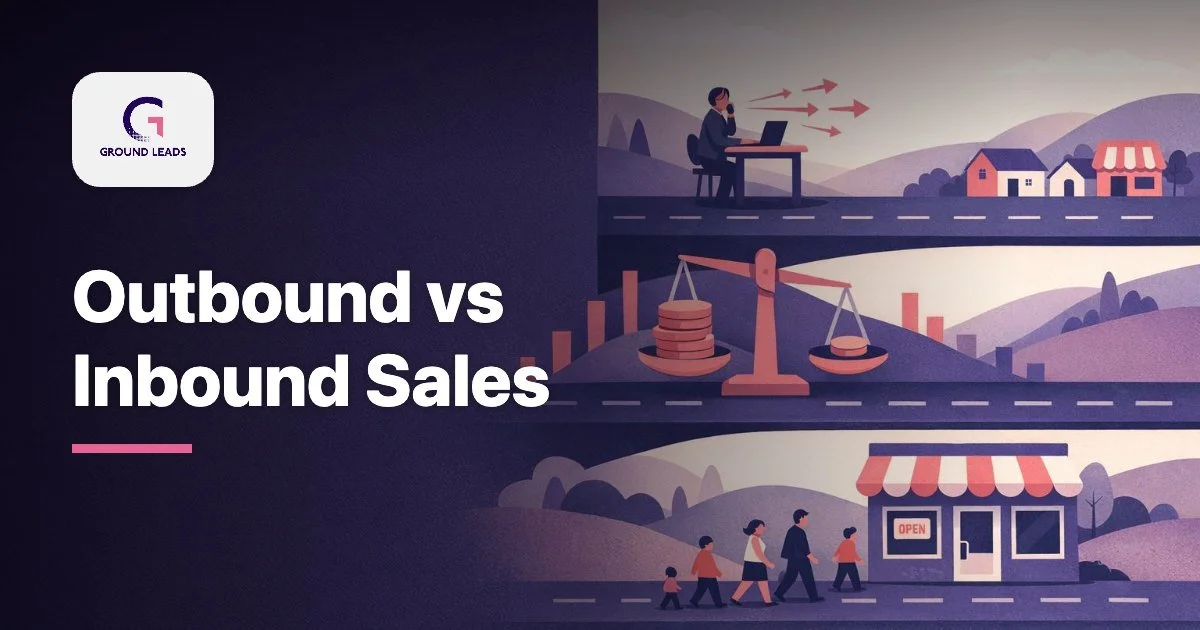


Inbound got you to $1-3M ARR. It won't get you to $10M. Here's the brutal playbook for hunting enterprise deals without hiring SDRs or burning six months.